


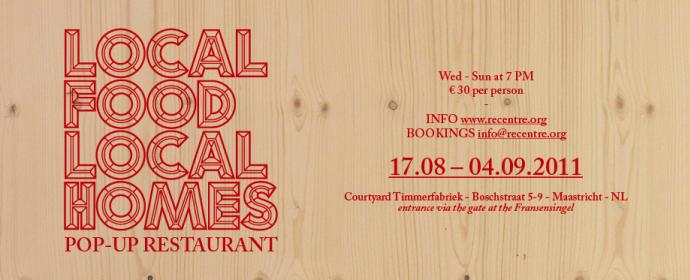
Local Food, Local Homes (c) Postcard of a Painting
Local Food, Local Homes: Pop-Up Restaurant
17.08.11 - 04.09.11
Think global, eat local!
Do you know where the food on your plate comes from? The Meuse-Rhine Euregion not only prides itself for a lot of delicious regional
products, it is also a producer of a lot of varieties of vegetables,
fruit, dairy, meat and even fish! But where does the produce from our own region go to? Why is it
the beans from Kenya and tomatoes from Israel that end up on our plate
and not the locally grown veggies, meat and other products?
REcentre has invited you from the 17th of August until the 4th of September 2011 to taste your own region and discover yourself what it is to 'eat local'.
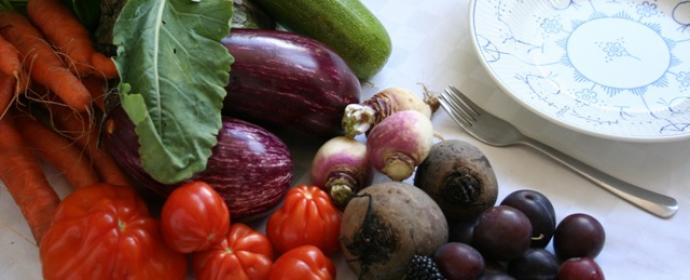
Chef Nora Rödner has gone around the Euregion to visit local producers and selected an array of products that were used in our very own pop-up restaurant.
Advised by some of the best chefs from the Euregion, she dished up a
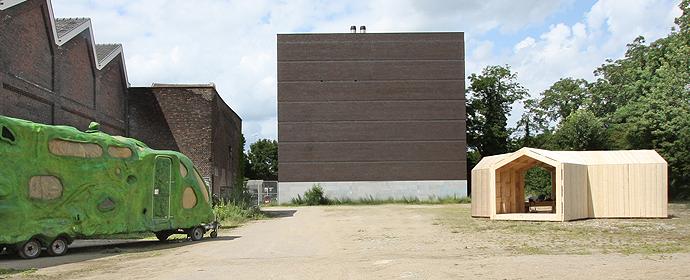
fresh, seasonal, deliciously local, menu every day. Our temporary restaurant has pop-up in the Dutch gastronomic capital
Maastricht where it was located in the backyard of the Timmerfabriek. Designers Agata Jaworska
and Giovanni Innella made a special contribution to the sustainability
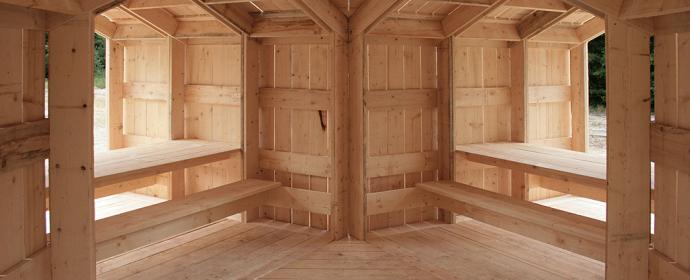
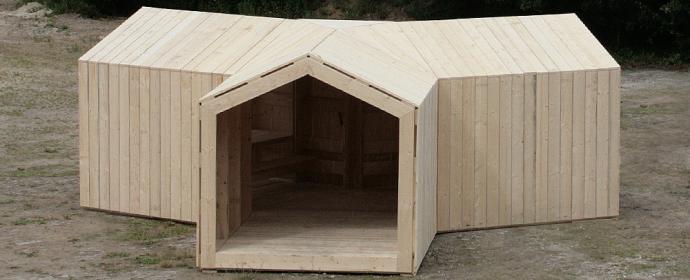
of the kitchen. The Pop-Up Restaurant was hosted in a beautiful pavilion designed by Maurer United Architects.
Design studio Institute for Relevant Studies (Agata Jaworska and
Giovanni Innella) made a special contribution to the interior of the
restaurant. Behind local food, there were local people, and their places
of work. Objects borrowed from six local producers were used to create an
interior installation that captured the current reality of producing
food in the region. Over the course of three weeks, six producers were featured. Objects like work shoes, tools and a work radio gave
direct input about the character and quality of the producers’ lives. The participating producers were winery and vineyard Wijngoed Thorn, Buffalo Foods Limburg, flour mill de Commandeursmolen, herb nursery PUUR Aroma , pigfarm Livar and 'frassiere' Edith Boënne.
Location: Timmerfabriek, Boschstraat 5-9, Maastricht
Bio designers Agata Jaworska and Giovanni Innella (Institute of relevant studies)
Institute of relevant studies is a design practice focused on doing more
with what already exists. Minimizing additional infrastructure and fixed costs,
the IoRS re-adapts existing resources and systems of exchange to create
and disseminate physical and digital goods, services and experiences.
IoRS sees business models as a form of design and expression.
Giovanni Innella and Agata Jaworska graduated cum laude from IM masters
of the Design Academy Eindhoven. They collaborate with companies and
institutions such as Interaction Design Lab, Droog, Naba and Design
Academy Eindhoven amongst others. Their projects have been exhibited at
MOMA New York, NAi Maastricht, Architectural Biennale Venice, Stedelijk
Museum and have been published in Time magazine, Domus and Abitare. They
have lectured at Gerrit Rietveld Academy, Strelka Institute and Royal
College of Art, amongst others.
Bio Maurer United Architects
Maurer United is known for investigating and redefining the borders of
the architecture design-field, resulting into urbanism, architecture,
design and media projects on various scales. Since 1998 Marc Maurer and
Nicole Maurer have received several awards and nominations for their
cooperative work. They have tutored at different academies and
universities in the Netherlands.
Their works – architecture, public spaces, interior design and art
installations – have been realized all around the world, i.e. the
Netherlands, Germany, USA, China. Maurer United is based at the central
railway station building of Maastricht. The office counts architectural,
graphic and industrial designers, as well as experienced building
project managers and technical drawers.Maurer United launched a polycultural beer, named Loorberger, especially for this event.
Local Food Supply Chains
Every food item has a “food miles” count, the more miles your food had
to travel to get to your plate, the more (scarce) fossil energies were
used and the more carbon emission it caused. Obviously, the smaller the
food miles, the better. Still, food items that travelled half around the
world are a common sight in our supermarkets.
Strange, if you think about it. Is it really that necessary to have our
strawberries flown in from Spain when they also grow at our own farms?
With a growing amount of food miles as only one of the many challenges
the food supply chain is facing at the moment, it is not difficult to
conclude that our current food system is everything but sustainable. Smaller scale food production such as urban agriculture and local food
systems can contribute to the right answer to our current industrialized
system.
Local food systems support the local and regional economy, bring
environmental benefits through more sustainable production systems, can
help maintain biodiversity, reduce food miles and create opportunities
for circular systems based on organic waste, residues and renewable
energy.
There is hope; local food systems are popping up in more and more places around the world. And why shouldn't the Euregion be amongst those systems?


